Geomagnetic Storm Threatens $40 Billion Loss for Satellite Industry; Tiny Startup Races to Improve Forecasts
Breaking: Space Weather Risk Soars as Satellite Fleets Expand
A single geomagnetic storm could cost the satellite industry $40 billion, according to new risk analysis, as the number of active spacecraft in orbit continues to explode. With over 8,000 satellites currently operational and projections of more than 25,000 by 2030, the financial exposure has never been greater.
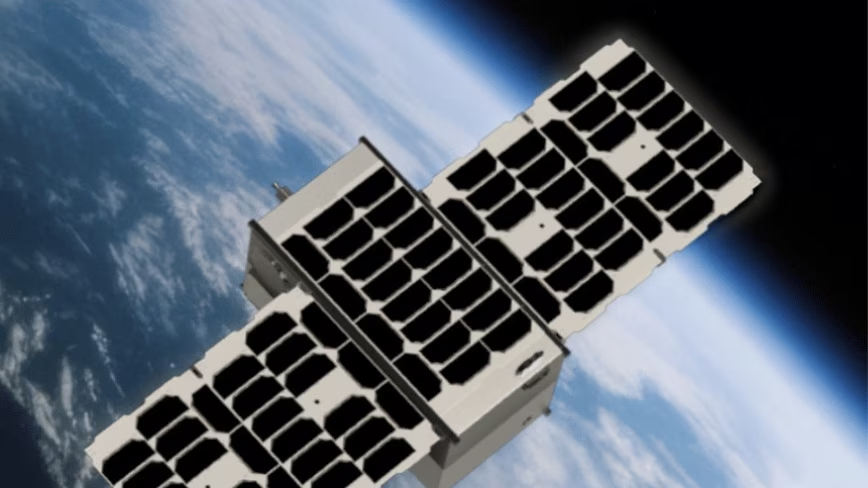
The threat is not hypothetical. In February 2022, a moderate storm knocked 40 freshly launched Starlink satellites out of orbit, a preview of the damage larger events can inflict.
“We’re facing a perfect storm of rapid constellation growth and increased solar activity,” said Dr. Sarah Chen, space weather analyst at OrbitalRisk. “A major event could disrupt navigation, communications, and remote sensing globally, with losses cascading across the insurance and telecom sectors.”
Background: Solar Maximum and Satellite Vulnerability
The sun produces several hundred geomagnetic storms during its 11-year solar cycle, especially during the solar maximum expected around 2025. These storms can expand Earth’s atmosphere, increasing drag on low-earth orbit satellites.
Without accurate forecasts, operators lose valuable time to maneuver spacecraft to safer altitudes. The current warning system relies on aging magnetometers and solar observatories with limited lead time.
What This Means: A Race for Better Forecasting
A 15-person startup called AetherWatch is developing a new forecasting platform that combines machine learning with real-time solar wind data. Their system aims to provide 12- to 24-hour advance warnings, giving operators time to adjust orbits or shut down sensitive electronics.

“We’re building the equivalent of a hurricane tracker for space weather,” said Mark Rivera, CEO of AetherWatch. “Our goal is to reduce uncertainty from hours to days, potentially saving billions in avoided damage.”
The startup’s approach involves analyzing data from NASA’s Solar Dynamics Observatory, NOAA’s DSCOVER satellite, and ground-based magnetometers. They are currently testing their model with a major satellite operator.
Industry Impact
If successful, the forecasting tool could transform satellite operations. Insurance premiums for space assets might decrease, and network reliability for global broadband and GPS would improve.
However, the risk remains high during the upcoming solar maximum. Without improved forecasts, the industry faces a potential $40 billion loss from a single storm, comparable to the cost of a major hurricane.
Expert Warning
“We cannot afford to be complacent,” added Dr. Chen. “The next Carrington-level event could cripple entire constellations. Investing in forecasting is not optional—it’s essential.”
– Reporting contributed by The Next Web archives
Related Articles
- Understanding Chrome's Hidden 4GB AI Model: What It Is and How to Manage It
- 10 Exciting Revelations About Samsung’s July 22 Event: Galaxy Glasses, Watch 9, and Fold 8
- Mastering Long-Horizon Planning: A Step-by-Step Guide to GRASP
- The Container: Humanity's First and Most Essential Tool
- Breakthrough: Lab-Grown Pancreatic Cells Reverse Diabetes in Mice
- The Anti-Aging Magic of Travel: How New Places Keep You Young
- Amazon WorkSpaces Unveils AI Agent Desktop Access, Eliminating Legacy App Modernization Barrier
- Massive Asteroid 2026 JH2 to Skim Earth on Monday—Live Stream Available