7 Key Optimizations That Made JSON.stringify Twice as Fast
1. The Side-Effect-Free Fast Path
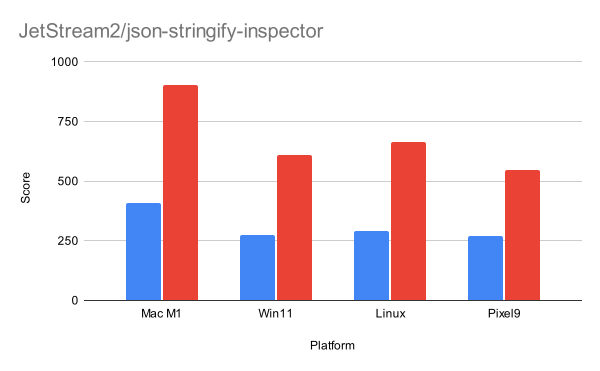
The core of the speedup lies in a specialized fast path that V8 can activate when it is certain that serializing an object will not cause any side effects. A side effect here refers to any operation that disturbs the straightforward traversal of the object graph—most notably, executing user-defined code during serialization. By guaranteeing no side effects, the engine can skip numerous expensive safety checks and use a streamlined implementation. This fast path is designed for the most common type of JavaScript objects: plain data containers. For details on what triggers side effects and how to avoid them, see Limitations on the Fast Path.
2. Avoiding Garbage Collection Interruptions
Even subtle internal operations, such as a garbage collection cycle, can break the fast path. The modern serializer carefully avoids actions that might trigger a GC while traversing an object. By preventing such interruptions, the engine remains on the highly optimized branch, eliminating pauses that would otherwise degrade performance. This is especially important when serializing large data structures, where even a single GC pause can multiply latency.
3. Iterative Architecture Over Recursion
The new fast path uses an iterative approach instead of the recursive algorithm found in the general-purpose serializer. Recursion required frequent stack overflow checks and complex state management for deep nesting. The iterative design removes these checks entirely, allowing V8 to process objects sequentially without fear of stack limits. This architectural change also makes it easier to resume serialization after encoding adjustments, further boosting throughput.
4. Unlocking Deeper Nesting
Because the iterative serializer eliminates stack overflow risks, developers can now serialize object graphs with significantly deeper nesting than before. Previously, deeply nested objects could cause the call stack to exceed its limit, resulting in a thrown error. With the new path, deeply nested structures—common in configuration files or complex state trees—are handled without issues, expanding the practical use cases for JSON.stringify.
5. Templatized String Handling for One‑Byte vs. Two‑Byte
Strings in V8 are stored in two internal representations: one-byte (ASCII) and two-byte (UTF‑16). To avoid constant branching on character type, the entire stringifier is now templatized. V8 compiles two distinct versions of the serializer: one optimized for one-byte strings and another for two-byte strings. This specialization removes runtime type checks and allows each copy to use the most efficient character encoding operations, doubling memory utilization for two-byte strings only when necessary.
6. Efficient Mixed‑Encoding Detection
During serialization, the engine must inspect each string’s instance type to determine its representation. This necessary check also serves to detect strings that cannot be handled on the fast path—such as ConsString, which requires flattening and may trigger a garbage collection event. By integrating this detection into the normal flow, V8 can quickly fall back to the slow path only when needed, keeping the majority of strings on the fast path while still correctly handling edge cases.
7. Balancing Performance and Binary Size
Compiling two specialized versions of the serializer increases V8’s binary size, but the performance gains are substantial. The team considers this trade‑off worthwhile, as the improvements affect a core JavaScript function used in countless applications. The fallback to the slow path for ConsString and other non‑fast‑path scenarios ensures correctness without sacrificing the speed benefits for the vast majority of cases. This careful balance ensures that JSON.stringify now operates more than twice as fast for typical workloads, making web pages more responsive and data serialization snappier.
Related Articles
- Enhancing Astro with MDX: A Q&A Guide
- Browser-Based PDF Compression: A JavaScript Q&A Guide
- YouTube RAM Bug Q&A: Why Your Browser Is Freezing and How to Fix It
- Rethinking Your CSS Strategy: When Mobile-First Isn't the Answer
- How to Transition to a Cost-Effective Aluminum Compound for Industrial Catalysis
- GCC 16.1 Brings C++20 Default, Experimental C++26 Support, and More
- Building a Date Range Selector with CSS :nth-child and a Touch of JavaScript
- V8 Engine Update Doubles JSON.stringify Performance: Faster Web Interactions Ahead