Boosting WebAssembly Performance with Speculative Inlining and Deoptimization in V8
Modern web applications demand ever-increasing performance, and WebAssembly has become a cornerstone for running computationally intensive tasks in the browser. Recent updates to V8, the JavaScript engine powering Google Chrome, introduce two powerful optimization techniques: speculative call_indirect inlining and deoptimization support for WebAssembly. Together, these features enable the engine to generate faster machine code by making informed assumptions based on runtime feedback. This article explores how these optimizations work, why they were not needed before, and the impressive speed gains they deliver—especially for WasmGC programs.
Understanding Speculative Optimizations in JavaScript
To appreciate the new WebAssembly optimizations, it helps to first look at how JavaScript engines have long used speculative techniques. In JavaScript, dynamic types make ahead-of-time optimization challenging. For example, when evaluating a + b, the engine may have observed that both a and b were integers in previous runs. Based on that feedback, the JIT compiler generates optimized machine code assuming integer addition. If the program later violates that assumption—say, by passing strings—the engine performs a deoptimization (or deopt): it discards the optimized code and falls back to a slower, general-purpose implementation while collecting more feedback for future re-optimization.
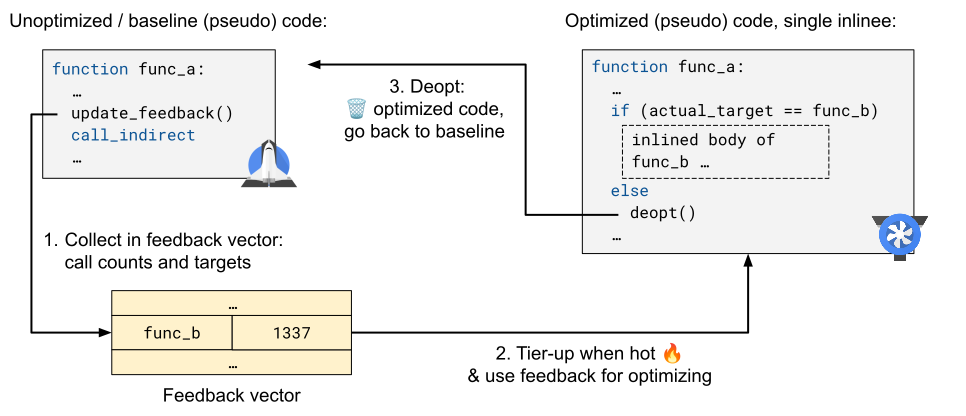
This cycle of speculation, optimization, and deoptimization has been vital for speeding up JavaScript execution without sacrificing correctness.
Why WebAssembly Initially Didn’t Need Them
WebAssembly 1.0, released in 2017, was designed with static typing and a compact binary format that made it much more predictable than JavaScript. Functions, instructions, and variables all have fixed types, allowing ahead-of-time compilers like LLVM (via Emscripten) or Binaryen to produce highly optimized code without runtime feedback. Because most early WebAssembly modules came from languages like C, C++, or Rust—which are already amenable to static analysis—the need for speculative optimizations was minimal. The engine could generate efficient machine code based solely on the static information present in the binary.
The Shift: WasmGC and New Opportunities
The landscape changed with the WebAssembly Garbage Collection (WasmGC) proposal. WasmGC extends WebAssembly to support high-level, managed languages such as Java, Kotlin, and Dart. These languages introduce complex features like structs, arrays, subtyping, and dynamic dispatch—concepts that are not easily optimized with static analysis alone. The resulting WasmGC bytecode is richer and more abstract than traditional Wasm 1.0, creating opportunities for runtime feedback–driven optimizations similar to those used in JavaScript engines.
One particularly impactful optimization is inlining. By profiling which functions are most frequently called—and with which types—the engine can speculatively inline those calls directly into the calling function, eliminating call overhead and enabling further compiler optimizations like constant propagation. This is especially valuable for virtual method calls in object-oriented WasmGC programs, where the call target may vary at runtime.
Deoptimization as a Safety Net
With speculation comes the risk of incorrect assumptions. V8’s new deoptimization support for WebAssembly acts as a safety net: if runtime behavior deviates from the speculative assumptions (e.g., a different method is called than expected), the engine gracefully transitions to unoptimized code without crashing. It then collects fresh feedback and may later re-optimize with updated guesses. This approach ensures that even if the optimizer’s bets are occasionally wrong, overall performance remains stable—and typically much faster than without speculation.
In Chrome M137 (released in early 2023), both speculative call_indirect inlining and deoptimization for WebAssembly were shipped together. The combination allows V8 to generate better machine code by making assumptions based on runtime feedback, a method that was previously limited to JavaScript.
Performance Gains and Future Potential
The impact on real-world applications is significant. On a set of Dart microbenchmarks, the combination of these two optimizations yields an average speedup of more than 50%. For larger, realistic benchmarks and applications—such as those used in productivity suites or data processing—the improvement ranges between 1% and 8%, with some scenarios showing even more substantial gains. While the percentage may seem modest for large apps, the absolute reduction in execution time can be critical for smooth user experiences.
Looking ahead, deoptimizations are not just a one-time fix; they serve as a foundational building block for even more advanced optimizations. For example, future versions of V8 could speculatively inline polymorphic calls more aggressively, shorten GC barriers, or even optimize type checks based on observed patterns—all while relying on deoptimization to handle mispredictions safely.
Conclusion
V8’s introduction of speculative optimizations for WebAssembly marks a new chapter in browser performance. By borrowing techniques from JavaScript JIT compilation—like inlining based on runtime feedback and safe deoptimization—the engine can now execute WasmGC programs significantly faster. As WebAssembly continues to evolve with richer language support, these optimizations will become increasingly important. Developers compiling Java, Kotlin, Dart, or other managed languages to WebAssembly can expect their applications to run more efficiently in Chrome, with further gains likely in future updates.
Related Articles
- Flutter Team Global Tour 2026: Events, Demos, and Community Connections
- Spotify's 'Honk' and 'Backstage' Automate Massive Dataset Migrations, Cutting Downtime by 80%
- Solar Solutions for Farm Resilience: A Step-by-Step Guide for Policymakers and Farmers
- Rivian Supercharges LA Retail Hubs with 150+ Fast Chargers and New Showrooms
- China Electric Vehicle Update: Highlights from Beijing Auto Show, Xiaomi SU7 Test Drive, BYD Developments, and New Home Battery Pilot
- WattEV Inks Landmark 370-Tesla Semi Order for Massive California Electric Truck Rollout
- Japan's Motorcycle Giants Accelerate Electric Ambitions: A Strategic Shift
- How to Navigate Flutter's Material and Cupertino Library Decoupling