Coastal Virginia Educators Mobilize with NASA to Build STEM Ecosystem Amid Climate Urgency
BREAKING: Regional STEM Alliance Forms in Coastal Virginia
In a significant push for climate-ready education, thirty-eight science educators from seven school districts across Virginia's Tidewater region are uniting with NASA and community organizations to build a STEM ecosystem that directly links classroom learning to real-world environmental monitoring. The collaborative effort, spearheaded by NASA eClips and the GLOBE Program, marks an urgent response to the growing need for data-literate students prepared for climate challenges.
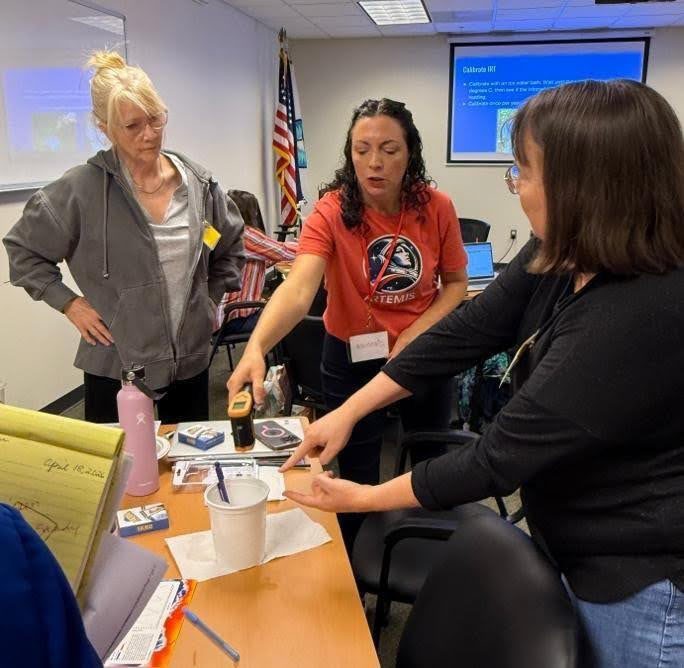
“This partnership is about empowering educators to use NASA’s authentic science resources and GLOBE’s citizen science protocols to make Earth systems tangible for students,” said Jessica Taylor, Physical Scientist at NASA Langley Research Center and Principal Investigator for GLOBE Clouds and the My NASA Data project. Taylor demonstrated the calibration of infrared thermometers during the hands-on professional learning sessions held at the National Institute of Aerospace (NIA) in Hampton on March 7 and April 18, 2026.
The initiative, supported by NASA’s Science Activation Program, focuses on integrating standards-aligned resources with direct community engagement. Educators are not only learning to use scientific instruments like infrared thermometers and multi-day min/max thermometers but are also practicing data collection via the GLOBE Observer app, contributing observations that feed into global environmental databases.
Hands-On Science in Action
During the intensive three-hour training, participants investigated how land cover drives surface temperature, how clouds affect atmospheric conditions, and how soil functions within environmental systems. These investigations were anchored by NASA eClips educational videos and GLOBE protocols, directly mapping to Virginia’s Science Standards of Learning for weather, climate, land cover, and Earth’s energy budget.
“We wanted to model authentic science practices that teachers can immediately take back to their classrooms,” a NASA eClips educator from NIA’s Center for Integrative STEM Education (NIA-CISE) stated. The training included an energetic cloud dance and a cloud opacity demonstration to illustrate atmospheric concepts in an engaging, memorable way.
Local community partners, such as the Elizabeth River Project, joined the effort to bridge classroom science with local watershed stewardship. This collaboration ensures that students can connect their classroom data to real restoration projects along the Elizabeth River.
Background: A Two-Year Collaboration Reaches Critical Mass
NASA eClips, a project within the agency’s Science Activation Program, provides free, standards-aligned educational resources that showcase authentic NASA science and engineering. Complementing this, the GLOBE Program (Global Learning and Observation to Benefit the Environment) empowers students and citizens globally to collect environmental data and contribute to scientific research.
The current initiative builds on two years of intentional collaboration between NASA eClips educators at NIA-CISE and GLOBE scientists at NASA Langley. The professional learning sessions are specifically designed to strengthen the regional STEM ecosystem by equipping educators with tools to engage students in citizen science projects.
What This Means
For classrooms in coastal Virginia, this means students will now have direct access to NASA-quality instruments and protocols to investigate local environmental issues like urban heat islands, land-use change, and climate variability. Teachers are gaining confidence in using data collection tools, which will translate into more hands-on, inquiry-based learning.
“When students see their own data being used by scientists to monitor things like urban heat or cloud cover, it changes their relationship with science,” Taylor added. “It makes them active participants in understanding and protecting their environment.” This initiative also sets a model for other regions looking to replicate NASA-community partnerships to bolster STEM education in the face of climate urgency.
The collaboration underscores a broader push within NASA to integrate educational efforts with community-based science, ensuring that the next generation is not only scientifically literate but also equipped to tackle pressing environmental challenges.
For more information about NASA’s Science Activation Program and resources, visit science.nasa.gov/learn.
Related Articles
- Squid and Cuttlefish Survived Mass Extinctions by Retreating to Deep-Sea Oxygen Havens, New Study Reveals
- How to Engineer a Memory Chip That Defies Miniaturization Limits
- The Vulnerability of Young Songbirds to Climate-Driven Temperature Extremes
- Quantum Leaps: Oxford's Pioneering 'Quadsqueezing' Breakthrough Explained
- How to Harness DeepSeek's SPCT Method for Next-Level LLM Reasoning at Inference Time
- Rethinking Efficiency: How AI's 'Bug-Free' Promise Can Erode Team Trust and Culture
- Mars Odyssey Team Marks 25 Years with a Stunning Global Map
- Mastering Coding Agents: A Q&A Guide to Harness Engineering