Mars Helicopter Rotor Blades Surpass Sound Barrier in Landmark Tests
In a groundbreaking series of trials at NASA's Jet Propulsion Laboratory, next-generation rotor blades designed for Mars helicopters have been driven past the speed of sound without suffering damage. Conducted in March within a specialized chamber that replicates the thin atmosphere of the Red Planet, these tests mark a significant leap forward for aerial exploration beyond Earth.
The blades' tips—the fastest-moving parts—were accelerated beyond Mach 1, and data from all 137 runs confirm their structural integrity under extreme conditions. This achievement paves the way for future aircraft capable of carrying heavier payloads, including scientific instruments and sensors, during low-altitude flights over Martian terrain.
Testing Beyond the Speed of Sound
The experiments took place inside the 25-Foot Space Simulator, a vacuum chamber that mimics Mars' atmospheric density and temperature. Engineer Jaakko Karras inspected each blade before and after supersonic runs, ensuring that the composite materials could withstand the punishing forces. The tests simulated the rapid rotation required to generate adequate lift in an atmosphere that is only 1% as dense as Earth's.

"NASA had a great run with the Ingenuity Mars Helicopter, but we are asking these next-generation aircraft to do even more at the Red Planet," said Al Chen, Mars Exploration Program manager at JPL. "That's not an easy ask. While everything about Mars is hard, flying there is just about the hardest thing you can do."
Why Supersonic Rotors Matter on Mars
On Earth, conventional helicopter rotors rarely push tips beyond Mach 0.9 to avoid shockwaves and efficiency loss. However, Mars' thin atmosphere forces engineers to be far more aggressive. To achieve meaningful lift, rotor tips must approach or exceed the speed of sound—something that would cause immediate failure on our planet. The successful tests prove that specialized blade designs can handle these extreme conditions.
- Thrust vs. Density: With 99% less air than Earth, blades must spin faster to move enough air molecules.
- Structural Limits: Supersonic speeds create shockwaves that can crack conventional materials; the new blades use advanced composites and shaping.
- Payload Gains: Higher tip speeds enable larger rotors or faster rotation, both of which increase lifting capacity for science instruments.
From Ingenuity to Heavy-Lifters
Ingenuity, which performed the first powered, controlled flight on another world on April 19, 2021, was a technology demonstrator without onboard science instruments. Its success proved that flight on Mars is possible, but it could only carry its own weight. The new blade tests are directly supporting NASA's recently announced SkyFall project and other concepts for aircraft that can haul gear across the Martian landscape.
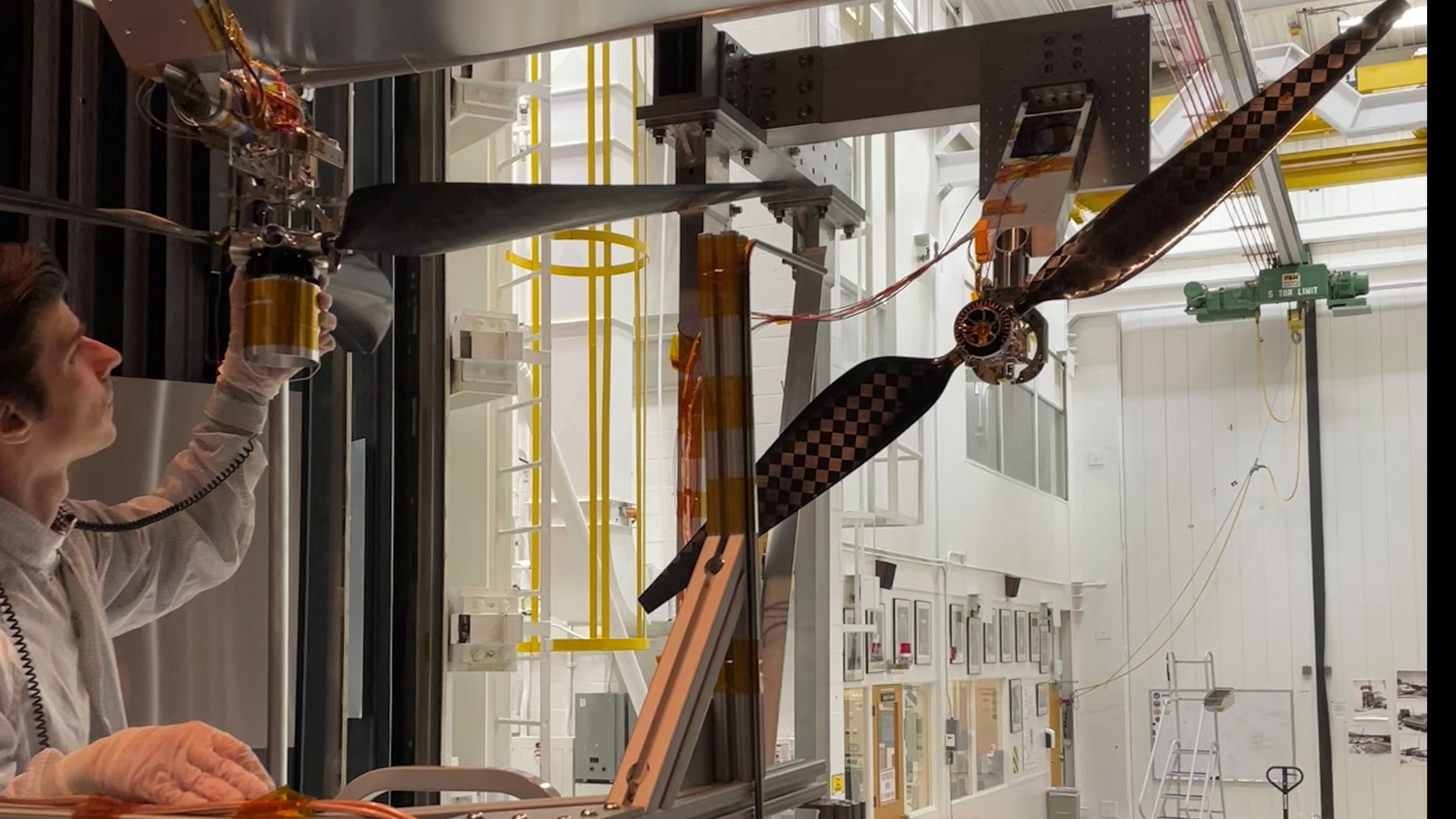
"By pushing rotors beyond the speed of sound, engineers are unlocking new possibilities for low-altitude aerial exploration of Mars."
— NASA/JPL-Caltech
Data-Driven Design for Future Missions
The 137 test runs generated comprehensive data on blade behavior at transonic and supersonic speeds. Engineers recorded vibration patterns, thermal loads, and aerodynamic forces. This information will feed directly into computational models for next-generation rotorcraft, allowing designers to optimize blade shape, thickness, and material composition.
Key insights include:
- Blade tips can sustain Mach 1.05 without structural failure.
- Shockwave attachment points remain stable over multiple spin cycles.
- Composite layering techniques reduce harmonic resonance at high RPM.
The SkyFall Project and Beyond
NASA's SkyFall project aims to develop a Mars aircraft capable of deploying small rovers or sensors from the air. The rotor blade breakthroughs are critical because SkyFall must carry its own deployment mechanism plus science payloads. Similarly, future sample-return or human-support missions could use helicopters to scout landing sites or retrieve cached samples.
"These tests bring us closer to aircraft that can do real science on Mars," noted a JPL spokesperson. "Imagine a helicopter that can fly into a canyon or over a dune field, carrying a spectrometer or a ground-penetrating radar."
Next Steps: From Lab to Mars
While the laboratory results are promising, engineers must still validate the blades under full-scale flight conditions. Plans include testing on Earth using a high-altitude balloon to simulate Martian atmospheric density, and eventually a flight demonstration on Mars. The data from the supersonic spin tests will be crucial for certifying the rotor systems for long-duration use.
In the fast-moving world of rotors, more thrust comes from a quicker spin or a larger diameter. On Mars, engineers must pursue both—but now they know the blades can handle the speed.
Related Articles
- How Scientists Discovered the Hidden Map in Your Nose: A Step-by-Step Guide to Understanding Smell Organization
- Google's Workspace Icon Overhaul Signals Brand-Wide Visual Shift; Fitbit Air, Samsung Glasses Also in Pipeline
- NASA Opens Bidding for Mars Telecom Network – Industry Must Deliver by 2030
- 10 Crucial Updates on the Artemis 3 Delay and NASA’s 2028 Moon Landing Race
- 10 Crucial Facts About Cyclone Maila and the Devastating Landslides in Papua New Guinea
- 10 Critical Facts About the Hidden Accelerant Driving Antarctic Ice Melt
- Nanobot Swarms: The Unexpected Robot Army Revolutionizing Medicine and Environment
- Breaking: Magic: The Gathering Unveils The Vision and Mind Stone, Confirms Ongoing Marvel Alliance