From Palantir to Quantexa: UK Tax Authority Bets Big on British AI to Close the Tax Gap
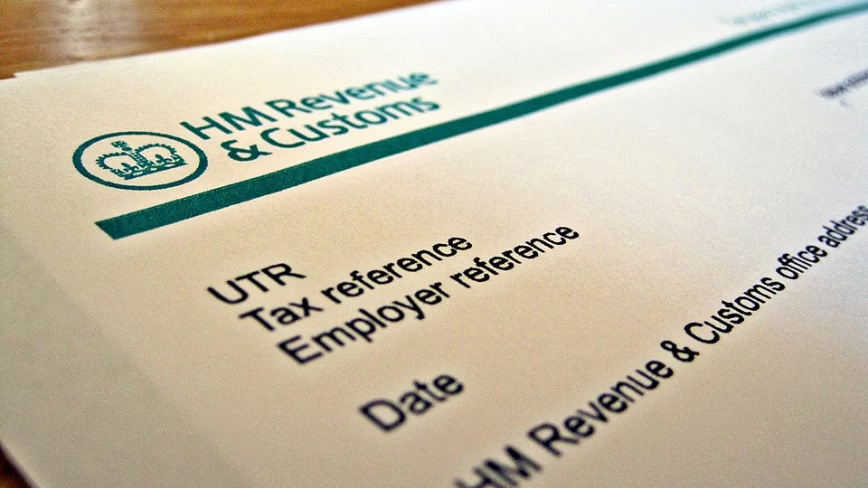
The United Kingdom's tax authority, HM Revenue and Customs (HMRC), has made a significant shift in its technology strategy. After spending approximately £900 million on contracts with US-based data analytics firm Palantir, HMRC has now awarded a £175 million, ten-year contract to London-based AI company Quantexa. This deal aims to modernise the tax authority's data infrastructure and deploy artificial intelligence to detect fraud, correct errors, and reduce the so-called 'tax gap' – the difference between taxes owed and taxes collected. The contract is one of the largest AI deals in UK public sector history, signalling a move towards homegrown technology solutions.
The Context: Previous Investment in Palantir
To understand the significance of the Quantexa contract, it is essential to look back at HMRC's earlier relationship with Palantir, the American big data company known for its work with intelligence agencies. Over the past few years, reports indicate that the UK government has spent close to £900 million on Palantir's platforms, primarily for data integration and analytics across various departments, including HMRC. These contracts were often criticised for their high cost and reliance on a foreign supplier, raising concerns about data sovereignty and the stifling of domestic tech innovation.
The New Deal: Quantexa's Ten-Year Contract
Now, HMRC is pivoting with a £175 million, ten-year award to Quantexa, a British AI company specialising in entity resolution and network analytics. This contract is not just a replacement of Palantir but a strategic investment in homegrown AI capabilities. The deal will see Quantexa's technology integrated into HMRC's core data systems, enabling real-time analysis of vast datasets to identify suspicious patterns, unpaid taxes, and administrative errors.
What Quantexa Will Do
Quantexa's platform uses advanced machine learning to build a unified view of individuals and businesses from disparate data sources. For HMRC, this means:
- Fraud Detection: Identifying complex evasion schemes that traditional rule-based systems miss.
- Error Correction: Spotting mistakes in tax returns and payroll data automatically.
- Tax Gap Closure: Pinpointing underpayments and unreported income across the economy.
The system is designed to help HMRC move from reactive audits to proactive, risk-based interventions, potentially recovering billions in lost revenue.
Why British AI? The Push for Homegrown Tech
The choice of Quantexa over established US competitors like Palantir underscores a broader UK government strategy to nurture local tech champions. With this contract, the government signals a preference for companies that keep data within the UK's legal jurisdiction and invest in local talent. Quantexa, founded in London in 2016, has grown rapidly and now employs hundreds of data scientists and engineers in the UK. The deal is expected to create more high-skilled jobs and strengthen the country's AI ecosystem.

Implications for UK Public Sector AI Adoption
This contract is a landmark for AI adoption in the public sector. It demonstrates a willingness to invest in large-scale, long-term AI projects that go beyond pilot programmes. The ten-year duration allows Quantexa to embed its technology deeply into HMRC's operations, develop custom models, and continuously improve the system as new fraud patterns emerge.
The Tax Gap Challenge
The tax gap in the UK is estimated to be around £35 billion per year. While HMRC collects roughly 95% of all taxes due, that missing £35 billion represents lost funds for public services. A significant portion comes from evasion by wealthy individuals and large corporations, as well as simple administrative errors. AI tools like Quantexa's can analyse billions of transactions, cross-reference data from banks, property registries, and company filings, and flag anomalies with greater accuracy than manual checks.
Conclusion
The £175 million Quantexa contract marks a new chapter in the UK's use of AI for tax administration. By moving away from Palantir's costly foreign tech and investing in a British AI firm, HMRC is betting that homegrown innovation can deliver better results, more control, and ultimately help close the tax gap. If successful, this deal could become a blueprint for other government departments seeking to modernise legacy systems with AI while supporting the domestic tech industry.
Related Articles
- SEAL: MIT's Framework for Self-Improving Language Models
- AI Agent Monitoring Crisis: New Framework Demands Real-Time LLM Evaluation and Observability
- Master Your Money: A Step-by-Step Guide to Using ChatGPT Pro's New Personal Finance Tools
- Testing the Unknowable: Navigating Non-Determinism in AI-Driven Development
- Meta Launches Adaptive Ranking Model to Bring LLM-Scale Intelligence to Ads, Driving 3% Conversion Lift
- OpenAI Issues Strict 'No Fantasy Creatures' Rule for Codex AI Coding Agent
- How Meta's Adaptive Ranking Model Transforms Ad Serving with LLM-Scale Intelligence
- How to Avoid the New AI Lock-In: A Step-by-Step Guide for Enterprise Buyers