Unlocking Community Knowledge: How Facebook Groups Search Got Smarter
Introduction
Every day, millions of people turn to Facebook Groups to find answers, share advice, and learn from others who share their passions. But with so many conversations happening across countless communities, locating the exact information you need can be a challenge. Recently, Facebook has fundamentally reworked its Groups search engine to help users more reliably discover, sort through, and validate community content. The result is a more intuitive experience that bridges the gap between natural language and the vast pool of knowledge within groups.

The Challenge: Three Major Friction Points
When searching for answers in community content, people often hit three specific barriers: discovery, consumption, and validation. Let's look at each one.
Discovery: When Keywords Let You Down
Traditional search relies on keyword matching—it looks for exact words you type. That creates a problem: what you say and what a community actually writes may not line up. For example, someone searching for “small individual cakes with frosting” might get zero results if the group uses the term “cupcakes.” The intent is clear, but the system misses it. Facebook set out to build a system where searching for an “Italian coffee drink” can match a post about cappuccino even if “coffee” is never mentioned.
Consumption: The Effort Tax
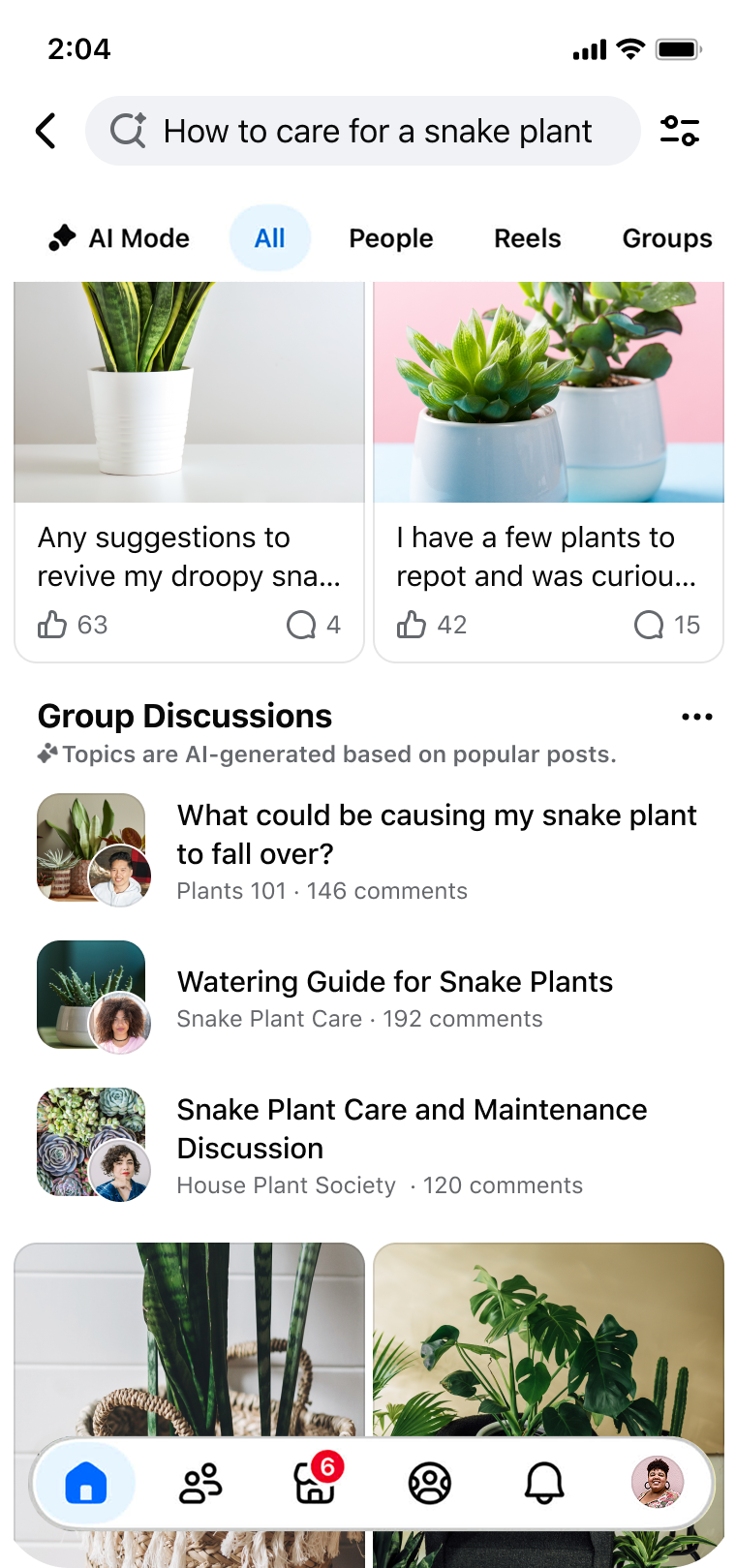
Even when you find the right thread, the real work begins. You often have to scroll through dozens of comments and piece together a consensus. Imagine looking for “tips for taking care of snake plants”—you'd need to read every reply to extract a watering schedule. This effort tax makes community knowledge hard to consume efficiently.
Validation: Trusting Community Wisdom for Decisions
Finally, people use groups to validate decisions—like before buying a vintage Corvette on Facebook Marketplace. They want authentic opinions from trusted experts, but that wisdom is scattered across many discussions. Unlocking it requires digging through multiple conversations, which is impractical at scale.
A Hybrid Retrieval Architecture: Beyond Keywords
To solve these problems, Facebook adopted a hybrid retrieval architecture that combines the best of both worlds: lexical (keyword) and semantic (meaning-based) search. Instead of merely matching words, the system understands the intent behind a query. It can now surface a post about “cappuccino” when someone asks about “Italian coffee drinks,” because it recognizes the conceptual connection.
This shift required rethinking how search indexes group content and how it ranks results. The new architecture is designed to handle the informal, varied language people use in everyday conversations.
Automated Model-Based Evaluation for Reliable Results
Any major change to search must avoid introducing new errors. Facebook implemented automated model-based evaluation to continuously measure relevance and engagement without slowing down the release cycle. This system automatically checks that the improved results don't come at the cost of accuracy. So far, the changes have led to tangible improvements in search engagement and relevance—with no increase in error rates.
How the New Search Works in Practice
Consider a user searching for “tips for caring for a snake plant.” Under the old system, they might miss a thread titled “My Sansevieria is thriving—here's my routine” because the word “snake plant” doesn't appear. Now, the system understands that “Sansevieria” is the scientific name for snake plants and surfaces that result. Similarly, a search for “how to refinish a wood table” can find posts that use synonyms like “sand” or “varnish,” even if those words aren't in the query.
The new approach also helps with validation. For someone researching a high-value purchase, the search can aggregate opinions from multiple threads and present them in a way that's easier to digest, reducing the effort tax. The system prioritizes content from trusted community members and signals like post engagement and recency.
What This Means for Users
The updated Facebook Groups Search is more than a technical upgrade—it's a transformation in how people tap into collective wisdom. Communities are treasure troves of knowledge, but they're only useful if you can find what you need quickly and trust the answer. By moving beyond simple keyword matching, Facebook is making it easier to discover hidden advice, consume it without unnecessary effort, and validate decisions with confidence.
For more details, you can read the original research paper published by Facebook.
Note: Internal anchor links like discovery, consumption, and validation help readers jump to specific sections.
Related Articles
- Fostering Amiability Online: Lessons from the Vienna Circle
- How Gen Z Redefines Truth in the Digital Age: The Blur Between Fact and Emotion
- How to Defend Your Organization Against the BlackFile Vishing Extortion Campaign
- Ultrahuman Ring PRO Returns to Kickstarter with Enhanced Features and Battery Life
- How Attackers Use Malicious Gems and Go Modules to Hijack CI Pipelines
- Navigating Airline Service Changes: A Guide to Understanding Delta’s New In-Flight Policies
- Decoding Spotify's Multi-Agent AI Framework for Ad Optimization
- Discover Windows' Hidden Gem: The Enhanced Notepad App from the Microsoft Store (It's Free)